

Best Claude Skills for Marketing: 6 Ad Picks
Find Claude marketing skills for ad research and creative briefs, then connect fresh competitor evidence with MCP tools so Claude has context to work from.
Updated October 5, 2026 · 9 min read
The best Claude skills for marketing make a specific workflow repeatable. To improve ad research, start with one marketing skill or a clear brand brief, then give Claude current competitor evidence through a trusted data source or MCP connection. Installing more skills alone does not give Claude up-to-date market information.
A useful setup has three parts: a skill that explains how to do the work, a brand brief that supplies the facts and constraints, and a data connection that retrieves current evidence. Claude can then help your team identify patterns and draft original ad hypotheses. A person still needs to review claims and test campaigns.
Disclosure and method: AdBase publishes this guide and is included in the connector comparison. We reviewed Claude’s official skills and marketing-plugin pages, public skill repositories and current MCP pages on 29 September 2026. We did not install every community skill or test each connector against an identical dataset. Public feature descriptions are vendor or repository claims, not product-test results.
Skills and MCPs solve different problems
Anthropic describes Skills as reusable, filesystem-based resources for instructions, context and workflows. MCP is an open standard for connecting an AI application to external data and tools. In plain terms:
| What Claude needs | Useful starting point | What it does not do by itself |
|---|---|---|
| A repeatable method | A marketing skill | Fetch current competitor data unless a connected source supplies it |
| Accurate brand context | A product, audience and claims brief | Prove that your product claims are true |
| Current market evidence | An MCP connection or a source you provide | Tell you whether a competitor’s ad is profitable |
| A creative decision | Claude’s analysis and draft | Replace human review or your campaign results |
The core distinctions are covered in Anthropic’s Skills documentation and the Model Context Protocol introduction.
Six Claude marketing skills and starting points
1. Claude’s official Marketing plugin: campaign and brand workflows
Anthropic’s Marketing plugin describes reusable workflows for campaign planning, brand review, competitive briefs, content drafting and performance reporting. The page we captured identifies Anthropic as the creator and says it installs in Cowork.
It is a good first place to look if you want a supported starting workflow inside Claude. Read the commands and configure your brand voice and style guide before asking for ad copy. A plugin workflow does not automatically know your product’s current offers or the latest competitor ads.
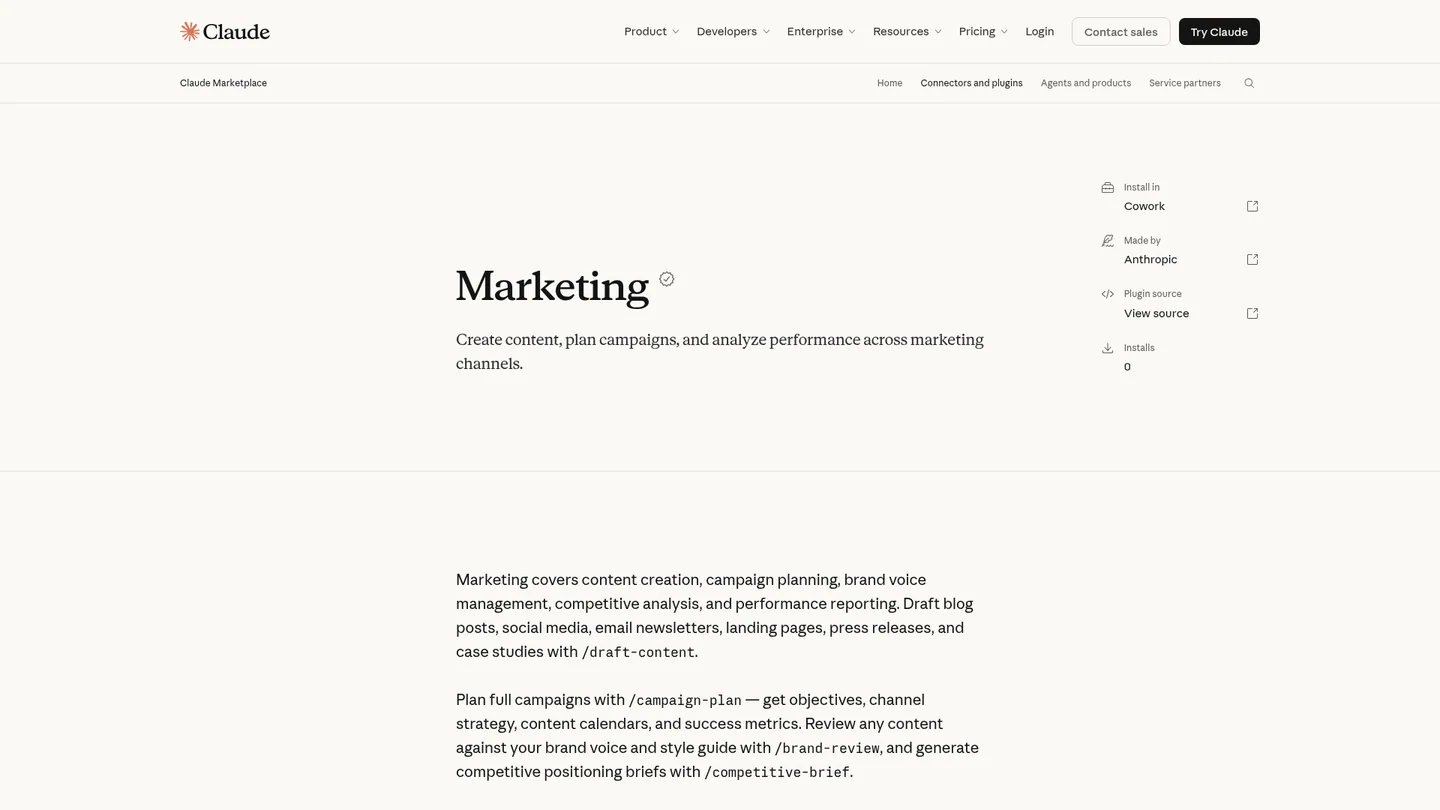 Official Claude Marketing plugin page, Firecrawl capture, 29 September 2026
2. Corey Haines’s marketing skills: focused open-source workflows
The public marketingskills repository groups reusable workflows around conversion optimization, copywriting, SEO, analytics, paid distribution and growth engineering. That makes it a practical repository to inspect if you want Claude to follow a defined process rather than repeatedly invent one.
Pick only the skills you need, review their instructions and adapt them to your own claims and review steps. Do not install a large bundle blindly; a skill is an instruction source, so read what it tells the agent to do.
The repository is open source and can be reviewed at Corey Haines’s marketing skills project.
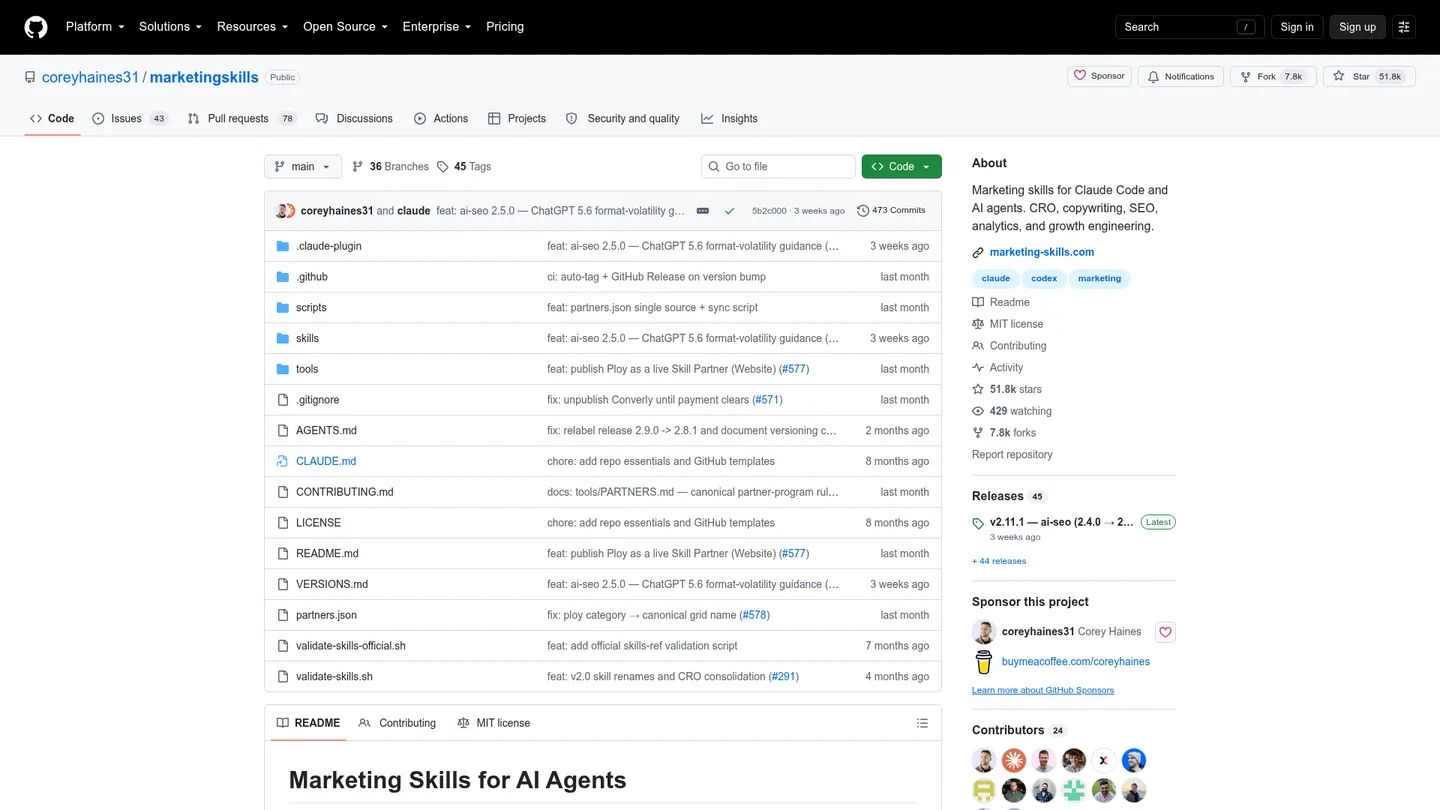 Public marketing-skills repository, Firecrawl capture, 29 September 2026
3. Alireza’s Claude skills collection: a broad catalog
Alireza’s public repository covers multiple business and technical roles, including marketing and research. It is a broad collection, so treat it as a catalog rather than a finished ad strategy. The useful step is to find one relevant skill, read its contents and decide whether its instructions fit your team’s process.
A generic skill cannot know which product claims you have approved, which customer segment matters most or which creative concepts your team has already tested. Add those facts separately.
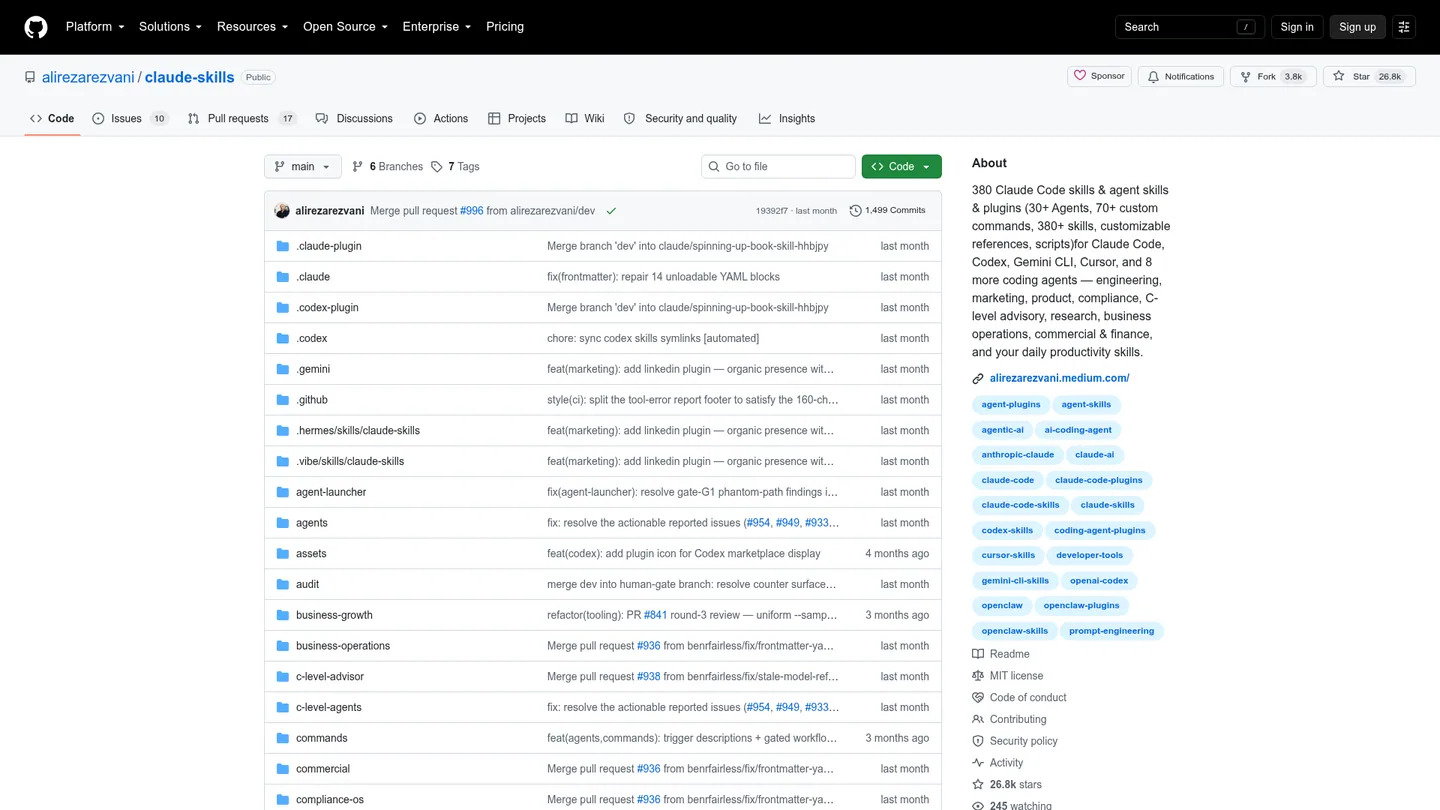 Public skills collection, Firecrawl capture, 29 September 2026
4. MKT1’s strategy-skill workflow: build your brand context first
MKT1’s guide is a walkthrough for creating a marketing-strategy skill from company context, ideal customer profiles, positioning and strategic exercises. It is a method for building your own context, not a ready-made ad-writing tool.
That distinction matters for ad quality. Before asking Claude for hooks, give it a short brief with the product, audience, offer, proof, objections, approved claims and words or claims to avoid. Revisit that brief when your positioning or product changes.
5. Composio’s list: a discovery index, not a quality ranking
Composio’s 2026 marketing-skills article collects examples across paid ads, SEO, research and other marketing jobs, and discusses pairing Skills with MCPs. It is useful for discovering names to investigate, but the list is a third-party catalog with a signup-oriented product page—not a neutral benchmark of skill quality.
Open the original source repository for any skill you consider, check its update history and inspect its instructions before installing. A list placement is not evidence that a skill is secure, maintained or effective for your business.
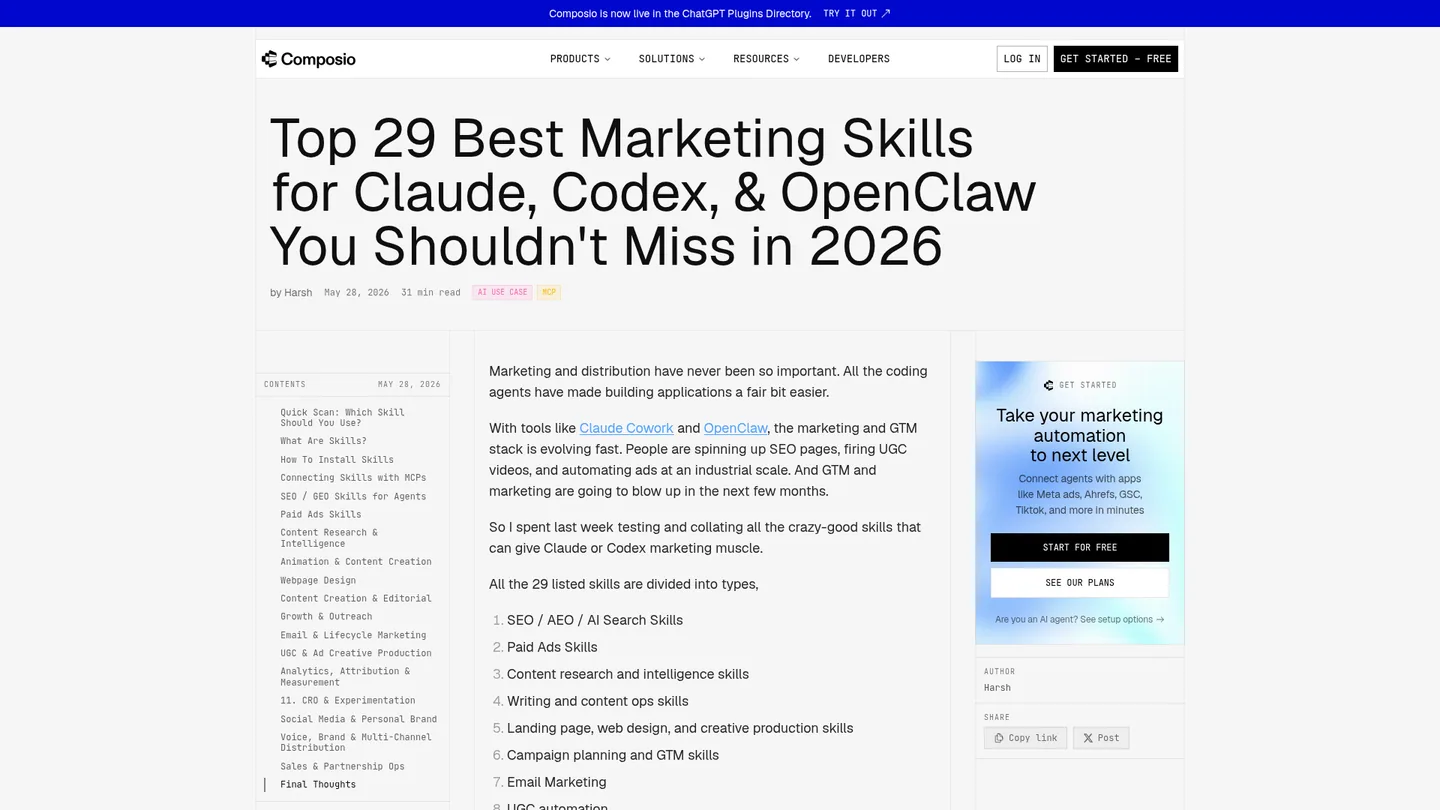 Composio marketing-skills guide, Firecrawl capture, 29 September 2026
6. A custom competitor-ad research skill: the most specific option
If your team repeats the same analysis every week, make a small skill for that exact job. Specify the inputs Claude should request, the evidence fields it should record, how it must separate observation from inference, and how it should turn a pattern into a distinct test.
A useful ad-research skill should require Claude to:
- cite the source and capture date for each observed ad or landing page;
- label what it can see separately from what it is inferring;
- avoid guessing a competitor’s budget, conversions or return on ad spend;
- use only product claims from your approved claim list;
- create new hooks and creative directions instead of paraphrasing a competitor;
- flag missing audience, offer or product information before drafting.
Store the company facts in a separate brand brief and keep the workflow skill focused on the method. This makes it easier to update positioning without rewriting every instruction.
MCP connections that give Claude current ad context
A skill teaches Claude how to work. An MCP connection can supply data to work with. These products publicly describe AI-client connections, but each one has a different research focus.
AdBase: competitor ads, emails and landing pages
AdBase’s current public site says it makes collected competitor ads, emails and landing pages available through Claude, ChatGPT, Codex and other compatible MCP clients. It also says setup and available features vary by client. Its in-product prompt starters include ad research and creative direction.
That makes AdBase relevant when your missing piece is competitor context in the AI workflow. Its public page labels the ad maker and ad manager as coming soon, so describe the current role as research context. Do not promise that AdBase writes, publishes or optimizes campaigns today.
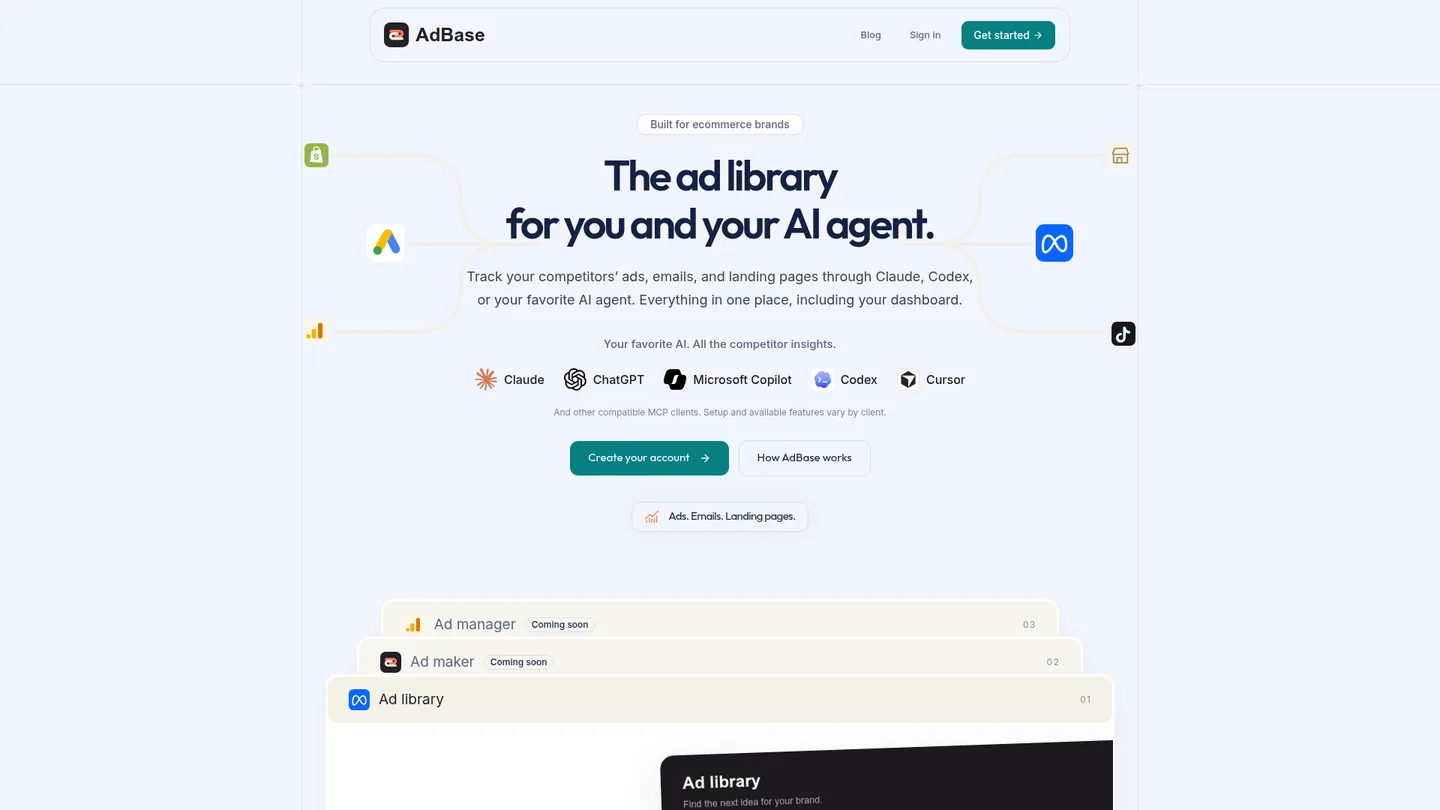 AdBase homepage with ad maker and manager marked coming soon, Firecrawl capture, 29 September 2026
Foreplay: creative discovery and a swipe-file workflow
Foreplay’s public pages describe ad discovery, saving and sharing creative examples, briefs and an MCP connection. Consider it if your team’s core job is organizing creative inspiration and moving it into internal briefs. Check which tracking, analytics and agent features are available on your plan. Our Foreplay ad library alternative page lists which Foreplay plans include the AI connection.
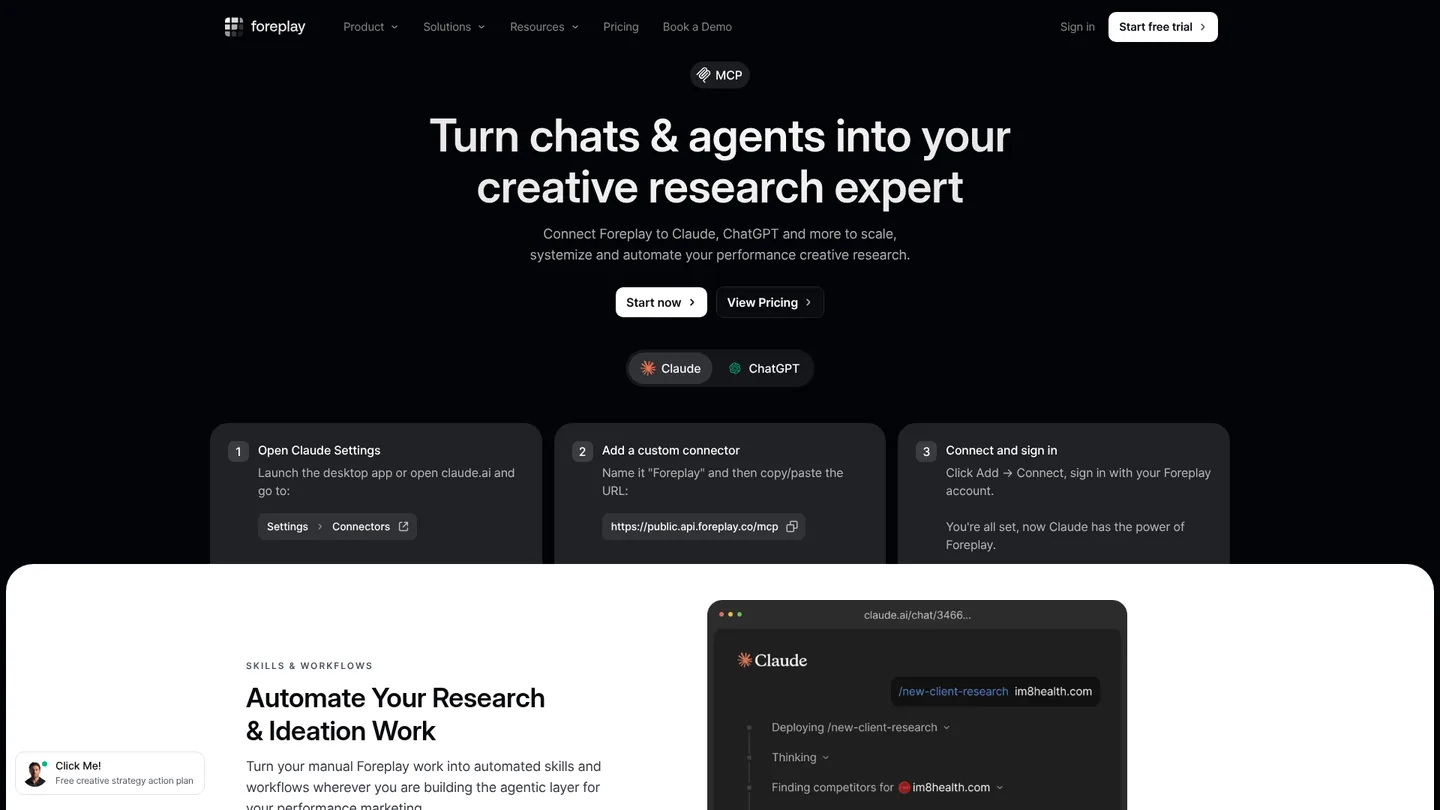 Foreplay MCP page, Firecrawl capture, 29 September 2026
TrendTrack: ecommerce shops, ads and advertiser context
TrendTrack’s MCP page presents access to ecommerce research around shops, ads, advertisers and emails. It can be worth evaluating if you want to connect ad examples with the stores and activity around them. Confirm the source coverage and plan limits relevant to the markets you serve. We compare its MCP plans with AdBase on the TrendTrack alternative page.
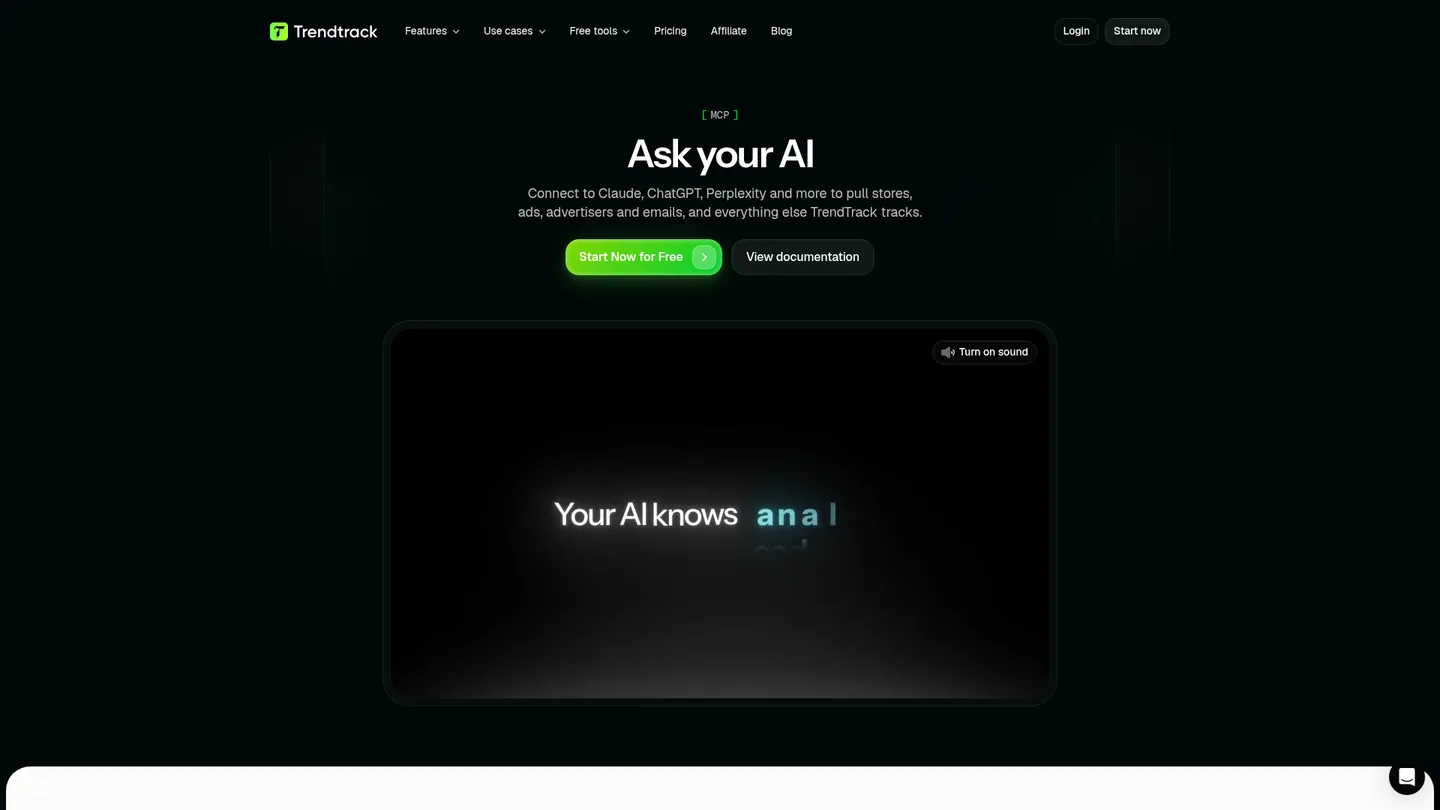 TrendTrack MCP page, Firecrawl capture, 29 September 2026
BrandSearch: market data through Claude or ChatGPT
BrandSearch’s public MCP page says it connects its market data to Claude, ChatGPT and other clients. Compare what its answers can cite and which records your plan can retrieve; the connector’s availability is not the same as proof that every answer is complete.
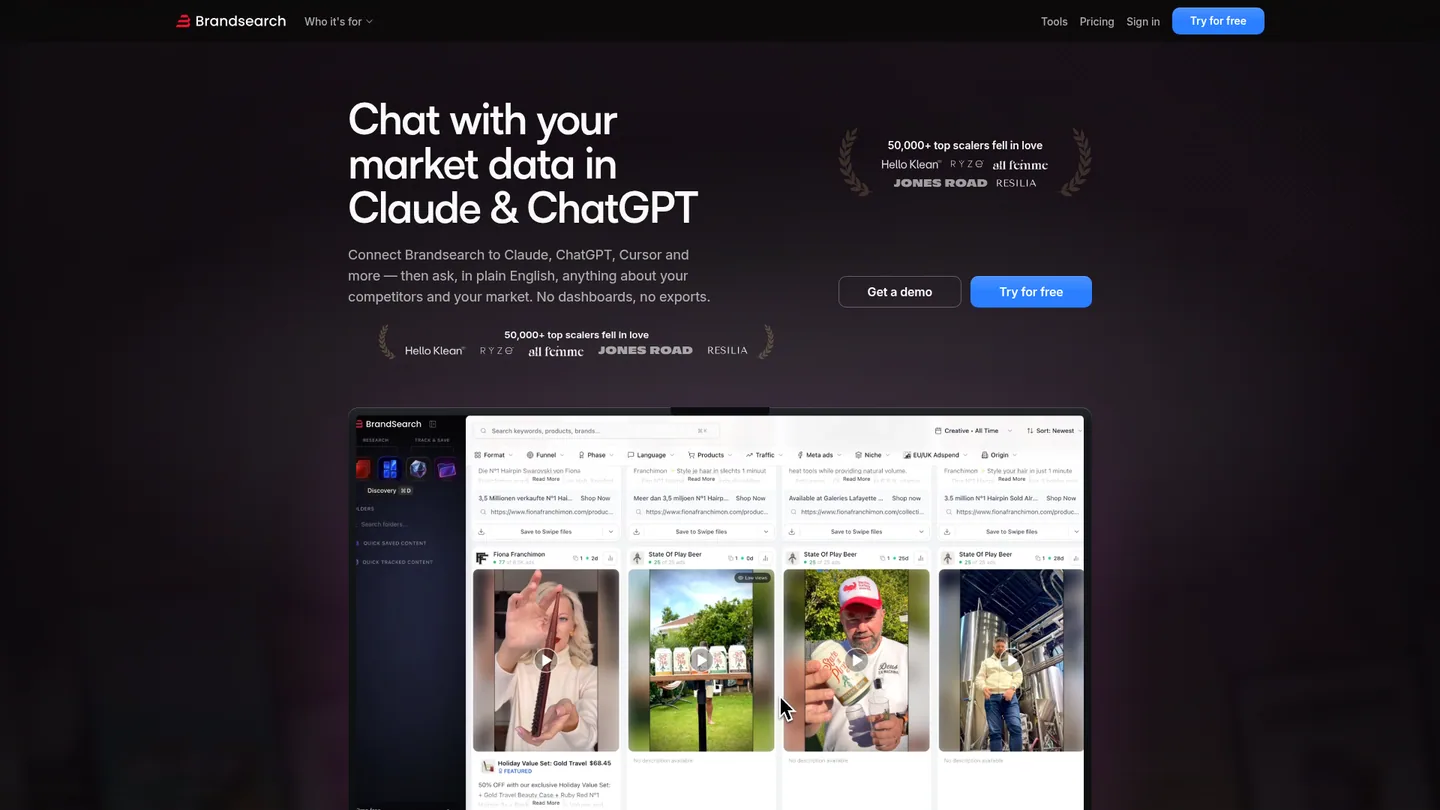 BrandSearch MCP page, Firecrawl capture, 29 September 2026
Atria and GetHookd also advertise MCP access for Claude and ChatGPT, on different plans. We checked their pricing on 5 October 2026 for our Atria alternative and GetHookd alternative comparisons, and the alternatives overview puts all of them side by side.
A repeatable Claude workflow for better ad ideas
Once your skill, brand brief and data connection are in place, give Claude a bounded job:
- Gather examples. Choose comparable brands, platforms and dates. Keep the original source attached to each example.
- Describe the evidence. Ask for hook, customer problem, offer, format, visible proof, CTA and destination. Keep direct observations separate from guesses.
- Find patterns. Ask which ideas recur across several examples and which are unique. Recurrence is a research signal, not a performance result.
- Make original concepts. Ask for several directions that fit your audience and approved facts, not rewrites of competitor ads.
- Review and test. Check claims and differentiation, then measure the new ads in your own campaign.
Prompt example:
Use only the competitor ads, landing pages and approved product facts attached to this request.

For every example:
1. Cite its source label and capture date.
2. Separate visible facts from inference.
3. Describe its audience problem, hook, offer, format, proof, CTA and landing-page promise.
4. Do not infer spend, sales, conversions or ROAS from its visibility or runtime.

Then propose three distinct ad concepts for our product. For each concept, include:
- the customer and problem
- an original hook, message and visual direction
- the approved product fact supporting each claim
- the offer and CTA
- one test variable and the metric we will measure

Do not copy distinctive wording, visuals or campaign structure. Flag any missing facts before drafting.
Frequently asked questions
What Claude skill is best for writing ads?
Start with a marketing workflow that includes brand voice and claim review, such as Anthropic’s Marketing plugin or a narrowly scoped skill your team has reviewed. Then supply current research and an approved product brief. A skill alone does not provide reliable facts about your competitors or your product.
Can Claude use competitor ads to write better ads?
Yes, as research context. Claude can summarize visible hooks, offers, formats and landing-page promises, then propose distinct ideas using your product facts. Public examples do not reveal the competitor’s actual sales or campaign results.
Is MCP a Claude skill?
No. A Skill is a reusable set of instructions; MCP is a protocol for connecting an AI application with outside data and tools. You may use both: a skill describes the research method, and an MCP server supplies records the method can analyze.
Can ChatGPT use AdBase?
AdBase’s current homepage lists ChatGPT among its compatible clients and notes that setup and available features vary by client. Check the current client-specific instructions before relying on a particular workflow.
Does AdBase generate or launch ads today?
Its current public site marks the ad maker and ad manager as coming soon. The present article describes using AdBase as research context for an AI workflow, not as a system that writes or launches the final campaign.