

Best Ad Spy Tools for Ecommerce Brands (2026)
Compare ad spy tools for ecommerce by channel coverage, saving, tracking and AI access. See which tool fits your workflow—and what ad data cannot prove.
Updated October 5, 2026 · 12 min read
The best ad spy tools for ecommerce depend on what you need to learn. Minea and PiPiAds focus on ecommerce product and creative discovery; AdSpy and BigSpy make broad ad-library searches; Foreplay helps teams save and organize creative; TrendTrack and BrandSearch connect market research to AI clients; Anstrex serves a different, native-ad niche.
No public ad library can tell you a competitor’s actual sales, spend or return on ad spend. Use what you can observe to form a hypothesis, then test an original idea against your own campaign data.
If you already use one of these tools and want to compare it with AdBase directly, our ad spy tool alternatives pages cover pricing, AI agent access and when each tool is the better pick.
How this guide was prepared: AdBase publishes this article and is included as a relevant research product. We compared public vendor pages, feature descriptions and pricing pages captured on 29 September 2026. We did not trial every product against the same advertiser list or measure campaign performance. “Best for” means the vendor’s current public positioning appears to fit that research job; it is not a hands-on test score. Prices and vendor-stated coverage can change.
Quick picks
| If your main job is… | Start your research with… | Check before buying |
|---|---|---|
| Finding ecommerce products and ad examples | Minea | Which platforms and product limits are in your plan |
| Researching TikTok Shop and short-form ads | PiPiADS | Whether its current credits and regions fit your workflow |
| Connecting ads to ecommerce shops and advertisers | TrendTrack | Which sources, history and MCP actions your plan includes |
| Saving, sharing and briefing creative examples | Foreplay | The seat, tracking and billing limits |
| Searching a wide range of ad networks | AdSpyder or PowerAdSpy | Coverage for your exact platform and country |
| Finding many Meta examples | AdSpy or BigSpy | How fresh the results are and what is included in the tier |
| Researching native, push or pop ads | Anstrex | Whether its specialist formats match your buying channel |
| Asking an AI agent about market data | AdBase, BrandSearch, Foreplay or TrendTrack | The data each connector can actually retrieve in your client |
How to choose an ad spy tool
Before comparing features, write down the decision you want the research to support. “Show me more ads” is not a useful goal by itself. A clearer question is “Which recurring offers and hooks should we test for this product category on Meta?”
Use five checks:
- Channel and country coverage. Confirm the actual platforms and markets you buy media in. “Multi-platform” can mean different things across vendors.
- Search and filters. Check whether you can search by advertiser, keyword, format, destination, date or product category.
- History and organization. Does the product help you revisit saved examples or track changes, or does it mainly return a snapshot?
- Context after the click. Can you inspect the shop, landing page or email around an ad? A creative without its offer and destination is incomplete evidence.
- Access for your team or agent. Check exports, collaboration and MCP support separately. A tool appearing in an AI workflow does not mean every client can access every feature.
We captured the vendor pages shown below with Firecrawl on 29 September 2026. Each image is an authentic public-page screenshot, resized without cropping. It shows what the vendor page displayed; it does not show a product test.
10 ad spy tools for ecommerce research
1. Minea: product and ad discovery for ecommerce
Minea is a sensible place to start when your research moves between ads, products and shops. Its public plan page lists Meta ads and product listings, with shop discovery, a brand tracker, notifications and AI ad analysis varying by plan. In the captured monthly view, Starter was listed at $49 per month; the page also showed a lower per-month rate for quarterly billing.
That makes Minea a fit to evaluate when you want product-discovery context alongside ad examples. If you mainly need to track named competitors, see our Minea alternative comparison. Check the exact platform coverage and monthly analysis limits that apply to the plan you would use.
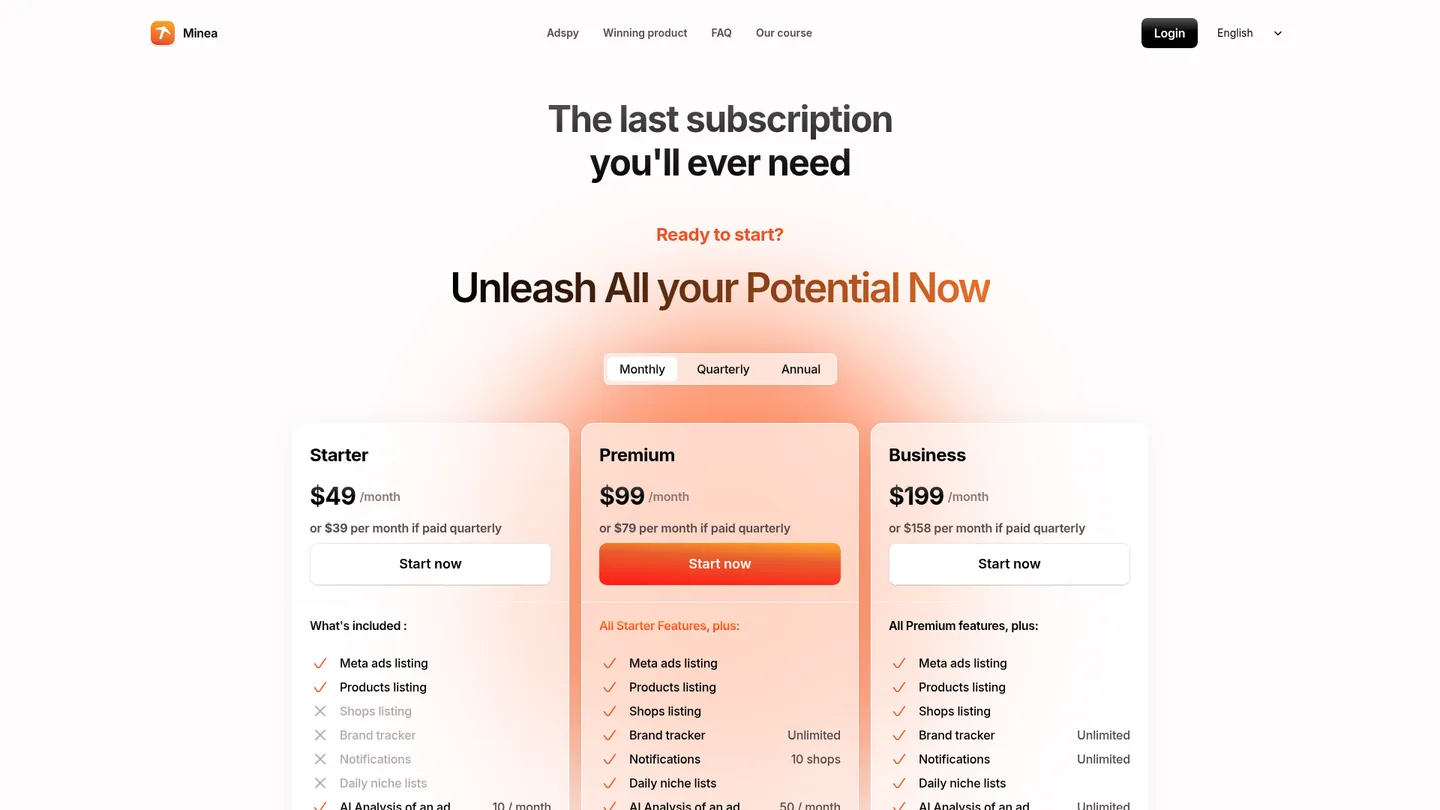 Minea pricing page screenshot captured by Firecrawl on 29 September 2026
2. PiPiADS: TikTok-focused ecommerce ad research
PiPiADS emphasizes TikTok advertising research, product discovery and advertiser tracking. Its public page also lists an ad tracker, influencer discovery and AI tools. That makes it worth comparing when short-form video and TikTok commerce are central to your testing plan.
The captured pricing page displayed $49 per month with a “Flash Sale” selector active. Treat that as a dated promotion, not a guaranteed ongoing price. Check credit limits, regions and the billing term before comparing it with another plan. Our PiPiAds alternative page compares it with AdBase.
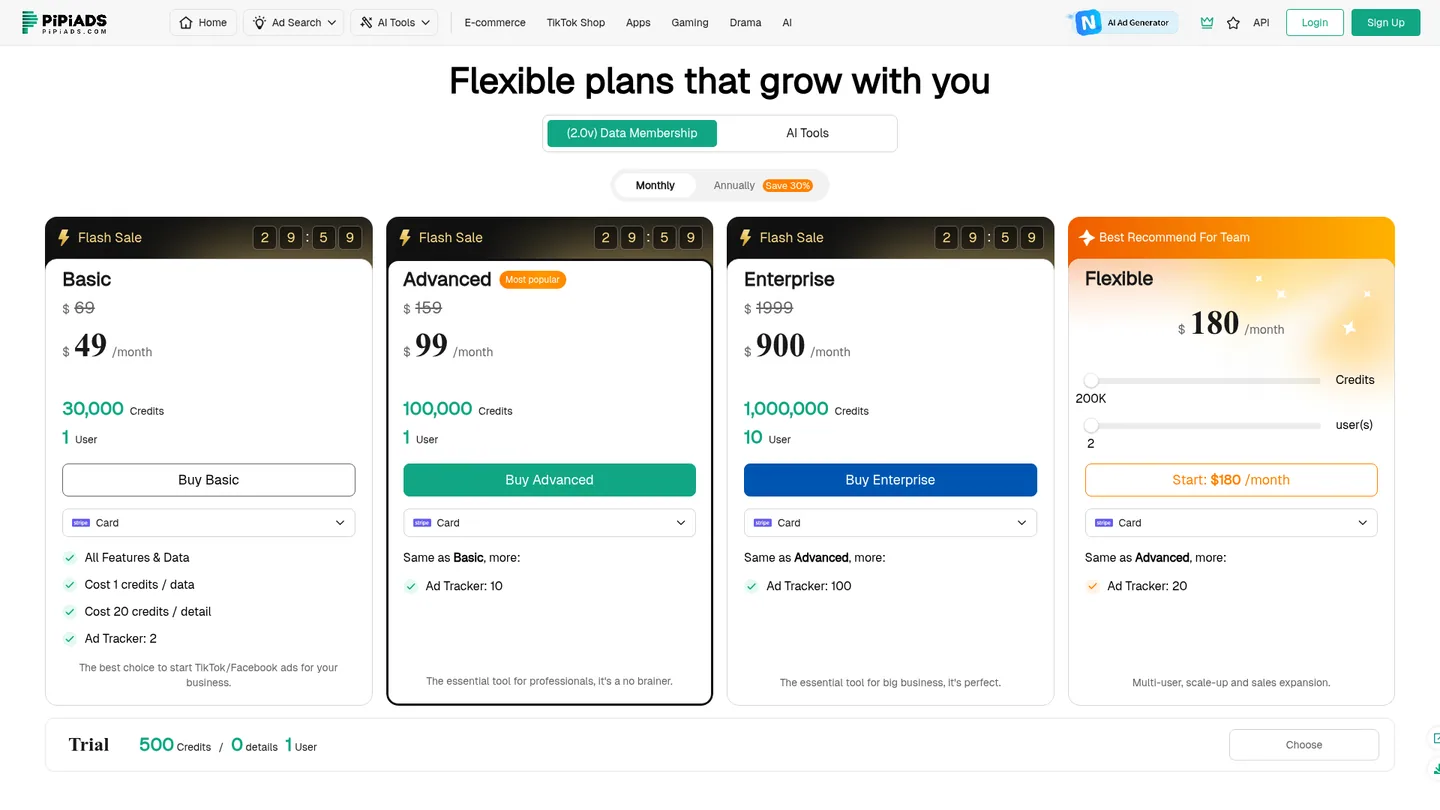 PiPiADS pricing page screenshot captured by Firecrawl on 29 September 2026
3. TrendTrack: connect ads to shops and advertisers
TrendTrack groups its product around shops, ads, advertisers and ecommerce research; its MCP page describes access to that data through AI clients. Its pricing page offers more than one billing mode, so compare the plan limits rather than a single headline price.
Consider it if your research question is “Which store is behind this ad, what else is it running, and how does that activity fit the market?” Confirm the sources, lookback period, alerts and MCP actions in the plan you are considering. Public feature descriptions are vendor claims, not an independent coverage audit. For a side-by-side with AdBase, see the TrendTrack alternative page.
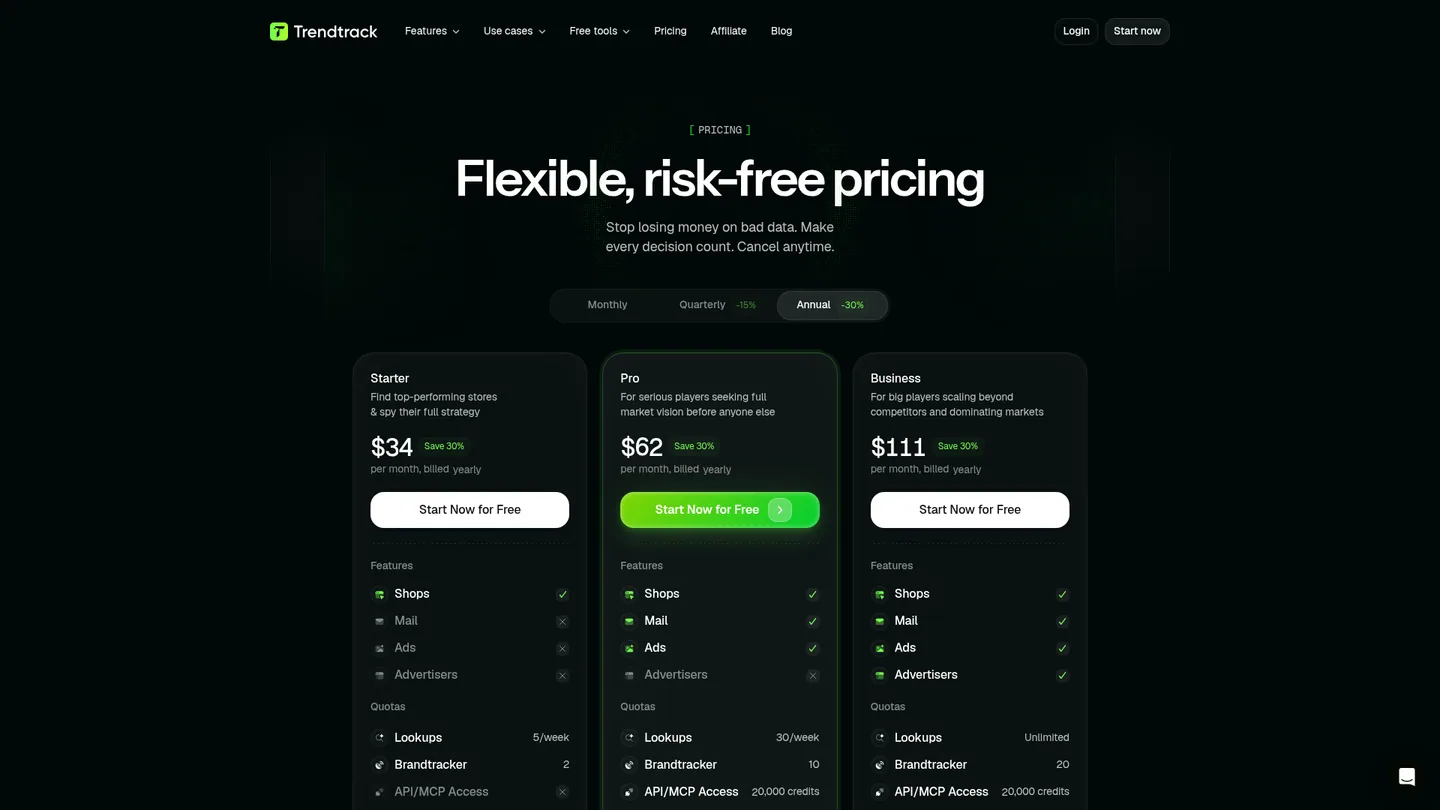 TrendTrack pricing page screenshot captured by Firecrawl on 29 September 2026
4. Foreplay: save creative and build a team swipe file
Foreplay combines ad discovery with a swipe file for saving and sharing creative examples. Its product pages also describe Spyder for competitor tracking, creative analytics, briefs and an MCP connection. That breadth can suit a team that wants research to flow into a reviewed creative brief.
The trade-off is that discovery, monitoring, analytics and collaboration can sit in different product areas and plans. Confirm which parts are included for your seats. Its pricing page showed separate monthly and annual billing options when captured. We compare it with AdBase on our Foreplay ad library alternative page.
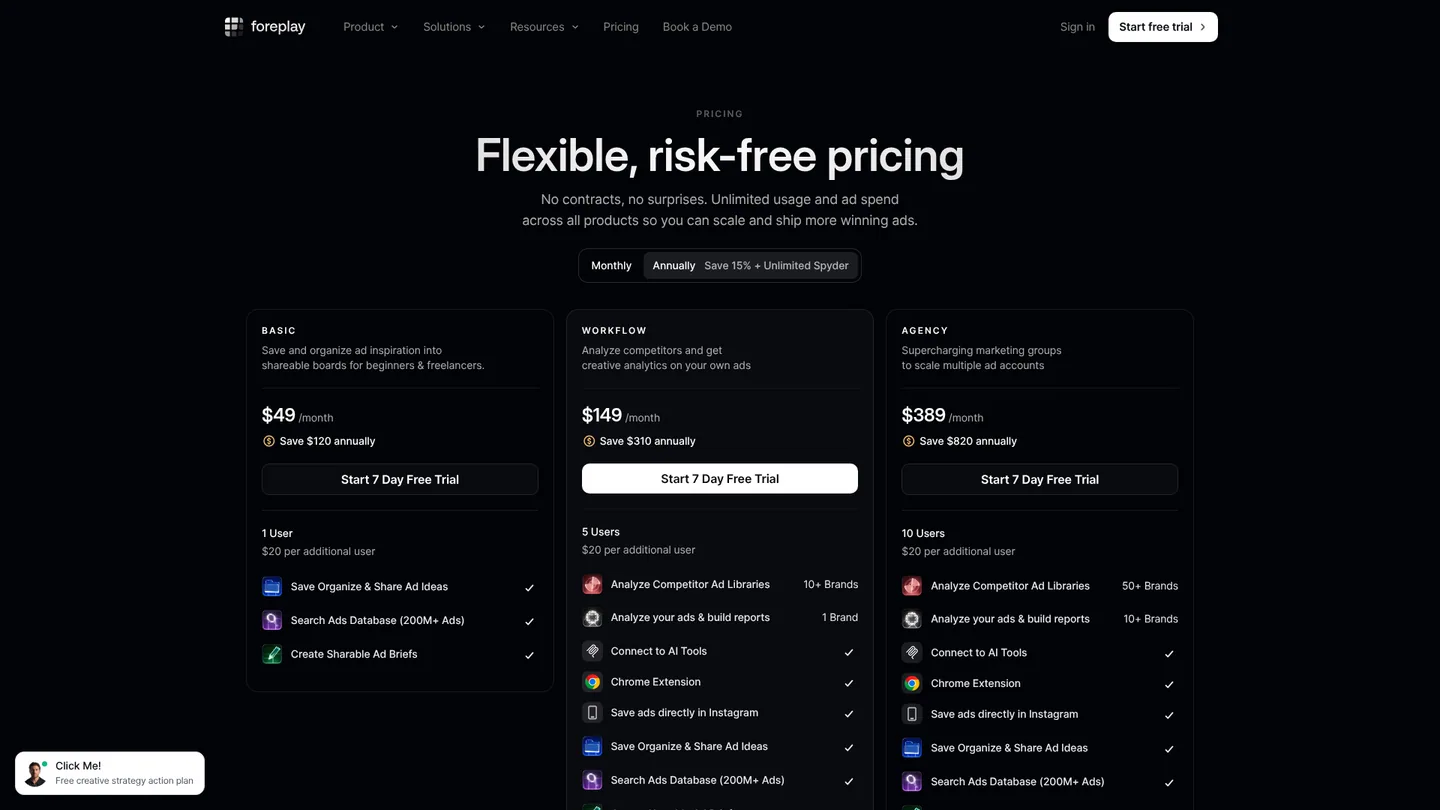 Foreplay pricing page screenshot captured by Firecrawl on 29 September 2026
5. AdSpyder: broad ad search with visible plan tiers
AdSpyder’s public library and pricing pages present search across multiple ad networks, including social, search, video and display sources. Its page showed monthly plans from $10 to $99, with search limits and features changing by tier.
It is a candidate when you need one interface for several ad sources. Check that the channels you care about are indexed with enough detail, and compare the actual search cap of the plan—not just its starting price.
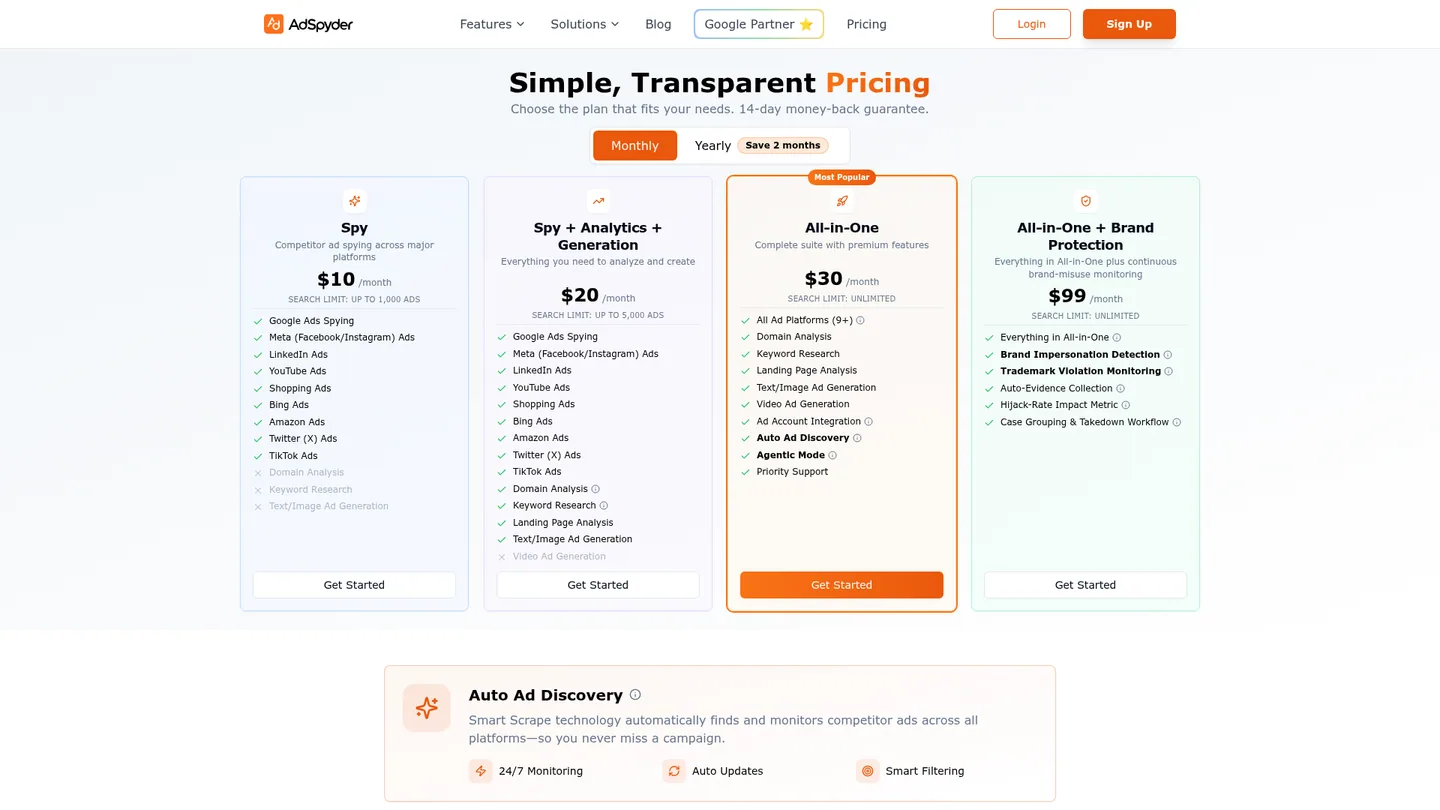 AdSpyder pricing page screenshot captured by Firecrawl on 29 September 2026
6. BigSpy: a broad visual ad library
BigSpy presents a cross-channel ad library with creative discovery and tracking features. The clean capture below is its public homepage. The separate pricing page returned plan text, but a welcome overlay obscured the pricing screenshot, so this guide does not use that image as price evidence.
For an ecommerce team, evaluate BigSpy by searching a fixed set of competitors on the platforms you actually use. Compare result freshness and useful filters, not the vendor’s total ad count alone. A large database can still be a poor fit if it misses your niche or destination context. Our BigSpy alternative page shows how its plans compare with AdBase.
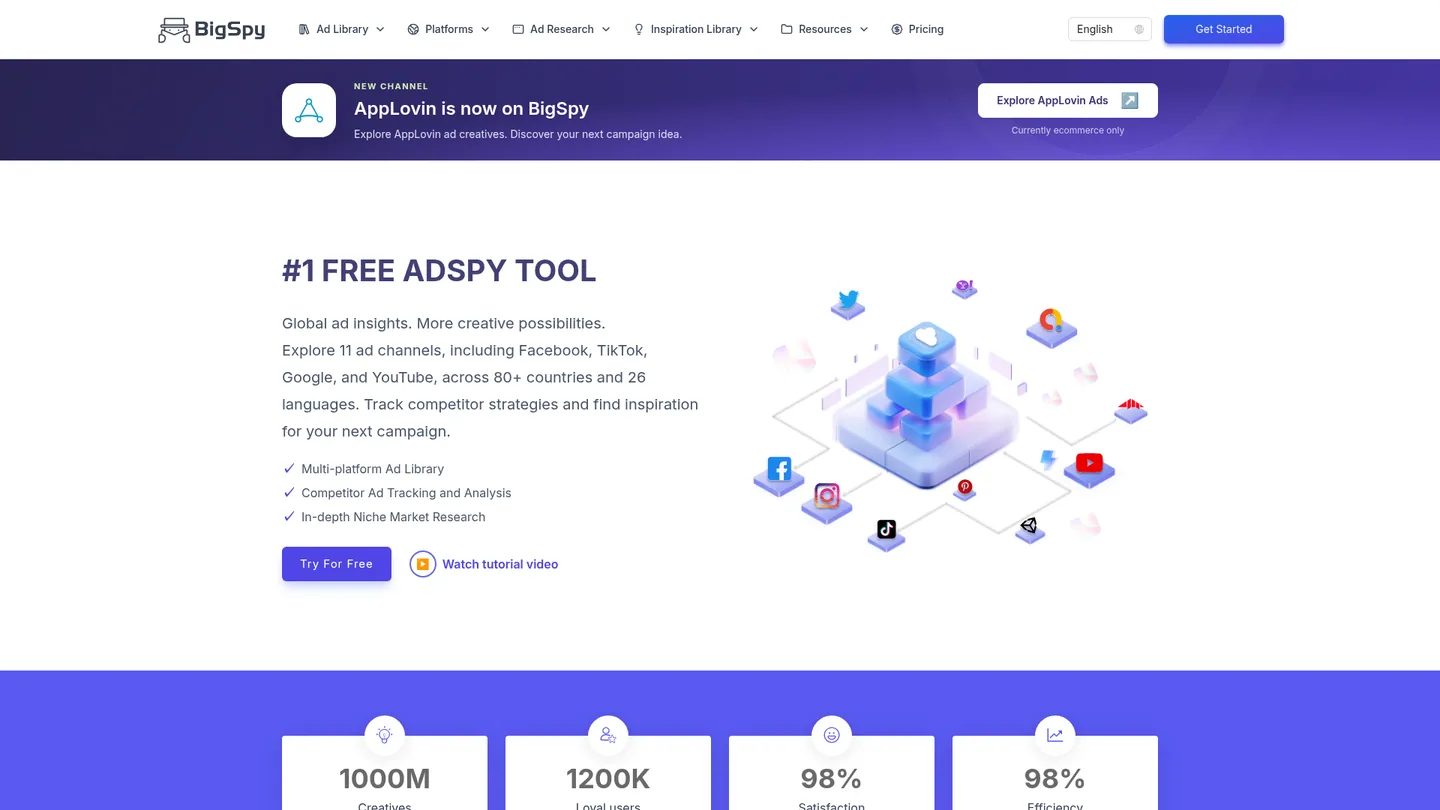 BigSpy homepage screenshot captured by Firecrawl on 29 September 2026
7. PowerAdSpy: multi-network research with a public trial offer
PowerAdSpy markets ad research across several networks and offers tiered access. Its pricing page showed a $69-per-month plan and a $1 trial for three days that renews at the displayed monthly price. Read the checkout terms carefully before starting any trial.
It may suit a buyer who wants to search several ad formats in one product. Verify the networks and filters included in the tier; broad coverage claims do not guarantee equally useful data on every channel.
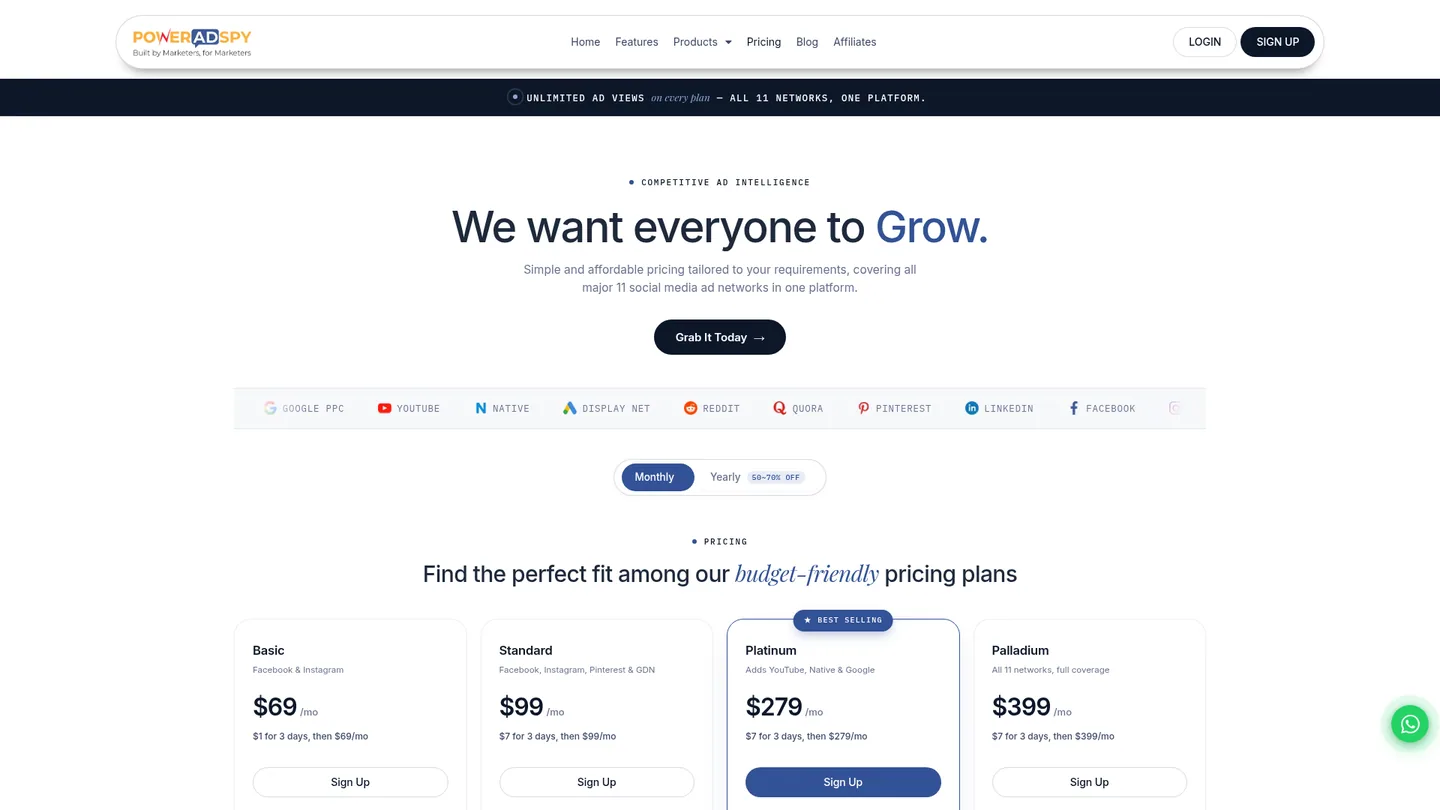 PowerAdSpy pricing page screenshot captured by Firecrawl on 29 September 2026
8. AdSpy: a Meta-focused archive
AdSpy centers its positioning on Facebook and Instagram ad search. Its homepage reported more than 211 million ads and 225 countries when captured. Those are vendor-published database figures, not independently audited counts.
Compare it when Meta is your main source and you want to investigate creative variations or advertiser activity. Ask how recent the underlying records are and whether the plan matches your search volume. Do not treat a reported archive size as proof that the data is complete or current. See the AdSpy alternative comparison for pricing next to AdBase.
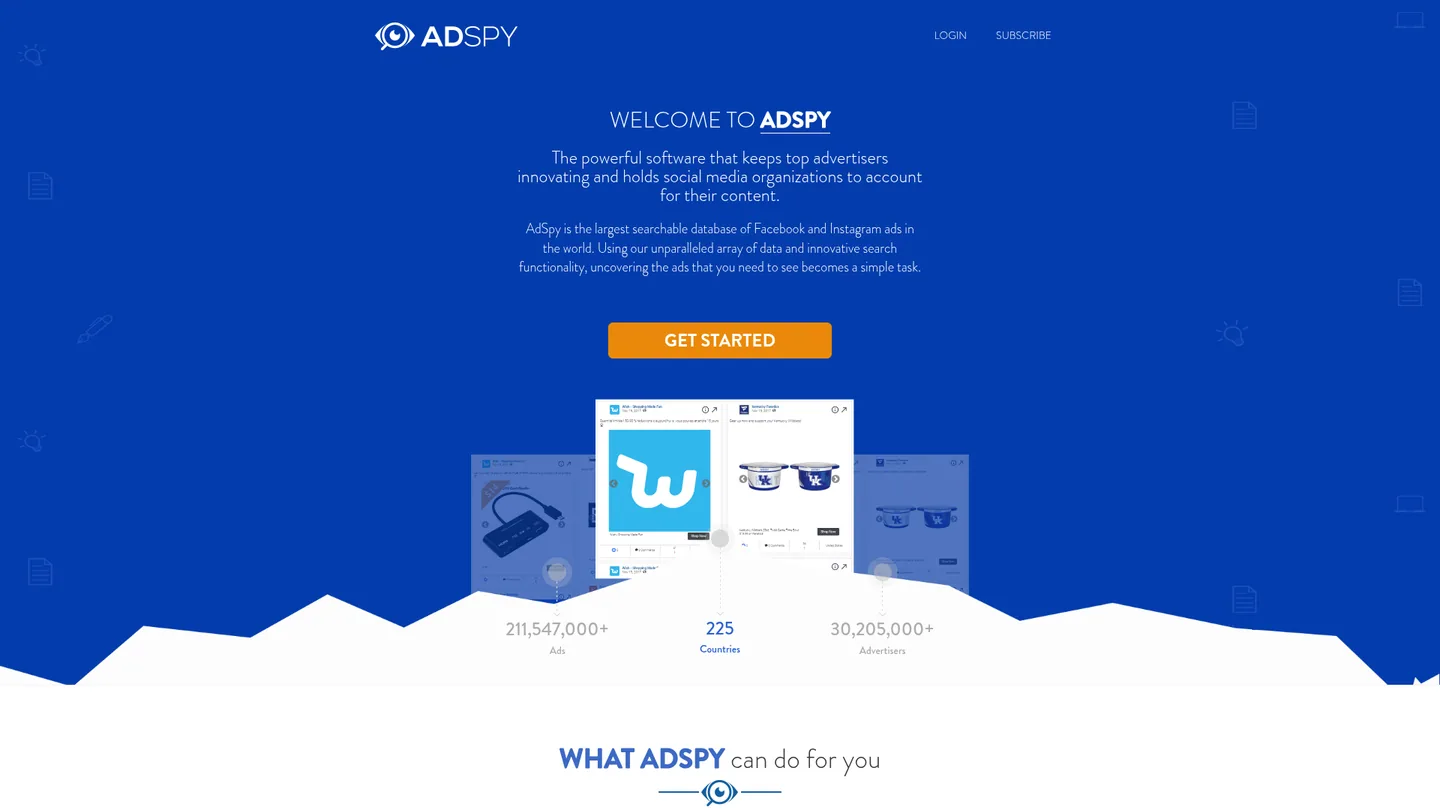 AdSpy homepage screenshot captured by Firecrawl on 29 September 2026
9. BrandSearch: market research inside Claude or ChatGPT
BrandSearch positions its MCP as a way to ask Claude, ChatGPT and other clients questions about market and competitor data. Its broader product pages are aimed at creative strategists, ecommerce brands and product researchers; the captured pricing page showed a Starter figure of $63 per month with the annual-billing discount selected.
Compare it if agent access is a central requirement. Ask what evidence a query returns, how you can inspect the underlying ad or shop, and which plan limits apply to MCP calls. A connector can make research easier to ask for, but it does not guarantee the answer is complete.
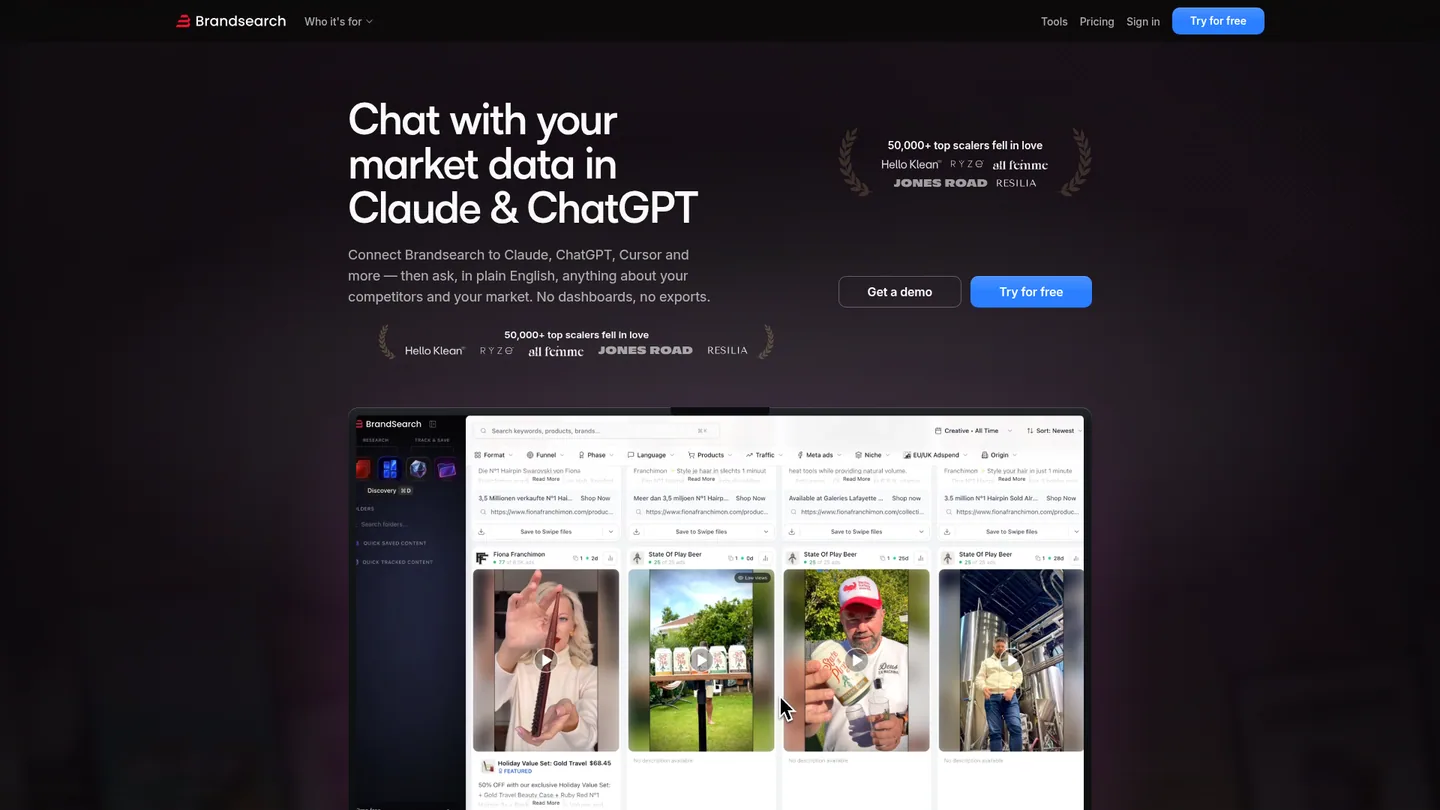 BrandSearch MCP page screenshot captured by Firecrawl on 29 September 2026
10. Anstrex: a specialist for native and other ad formats
Anstrex focuses on native, push, pop and in-stream advertising rather than being an ecommerce social-ad library first. That makes it a specialist to investigate if those formats are where you buy traffic.
The public pricing URL we checked displayed a “Page Not Found” page on 29 September 2026. No price is quoted here. Confirm current product availability and terms directly before including it in a buying shortlist.
 Anstrex homepage screenshot captured by Firecrawl on 29 September 2026
Turn competitor research into better ads
An ad spy tool should give your team examples to analyze, not templates to copy. Try this workflow:
- Save a small set of relevant examples from the same channel, market and customer category.
- Record what is directly observable: the opening hook, audience problem, offer, format, call to action and destination page. Keep the source and capture date with each example.
- Separate recurring patterns from one-off creative choices. A repeated offer may be worth researching; it is not proof that it converts.
- Ask Claude to propose a few original creative hypotheses for your product, using only the evidence and approved product claims you provide.
- Have a person check that every product claim is true, the execution is distinct from the references, and the landing page supports the offer.
- Test the ideas with your own campaign setup. Judge them on your actual business metrics, not on a competitor ad’s visible age or a vendor’s estimated engagement.
A prompt you can adapt:
Use only the competitor examples and product facts I provide.

First, list the observable evidence for each example and cite its source label. Separate observation from inference. Do not guess spend, conversions or ROAS, and do not treat an ad that remains visible as proof it is profitable.

Then propose three distinct ad concepts for our product. For each, give:
- target customer and problem
- a new hook and message
- format and visual direction
- the product fact that supports each claim
- call to action
- one test variable and what result we should measure

Do not reuse competitor copy, distinctive visuals or unsupported claims. Flag any missing product facts before drafting.
Where AdBase fits
AdBase is relevant when you want an AI client to work from a shared collection of competitor ads, emails and landing pages. The current public site lists Claude, ChatGPT, Codex and other compatible MCP clients, with setup and available features varying by client. Use Claude marketing skills and MCPs for ad research for a deeper workflow. Other tools with AI agent access include Atria and GetHookd; our comparison pages list which of their plans include it.
AdBase is research context, not an ad generator or campaign manager today: its public site marks both the ad maker and ad manager as coming soon. Your team still needs to review the evidence, choose an original angle, and launch and measure the campaign in its advertising platform.
Frequently asked questions
Which ad spy tool is best for Shopify?
Start with the job. Minea and PiPiADS emphasize ecommerce product and ad research; TrendTrack connects ads with shops and advertisers; Foreplay centers on saving and organizing creative; broad libraries such as BigSpy and AdSpyder offer a different search scope. Compare current plan limits against the platforms and markets your Shopify brand actually uses.
Can ad spy tools show which competitor ads are profitable?
Usually not from a public ad listing. An ad spy tool can show examples and may show vendor-estimated signals, but it does not give you the competitor’s verified sales, margin, spend or return on ad spend. Treat those signals as a lead to investigate.
Does an ad that runs for a long time mean it is winning?
No. It can be a clue that the advertiser has kept the ad active, but you do not know the budget, audience, conversion rate or reason it stayed live. Use duration to prioritize what to study, not as a performance benchmark.
Can Claude use an ad spy tool?
Some vendors advertise MCP connections or other AI integrations; others provide search, exports or saved libraries. Check the exact client, plan and actions supported. With AdBase, the current public claim is that compatible AI clients can access collected competitor context; setup and available features vary by client.
Can I copy a competitor ad and change a few words?
That is a poor research process. Identify the customer problem or offer pattern that is relevant, then develop a distinct message and creative for your own product. Check brand, legal and platform requirements before launch.
What is the difference between an ad spy tool and AdBase?
Ad spy tools focus on discovering or organizing public ad examples. AdBase focuses on making collected competitor ads, emails and landing pages available to supported AI clients as research context. The ad maker and manager are listed as coming soon.